


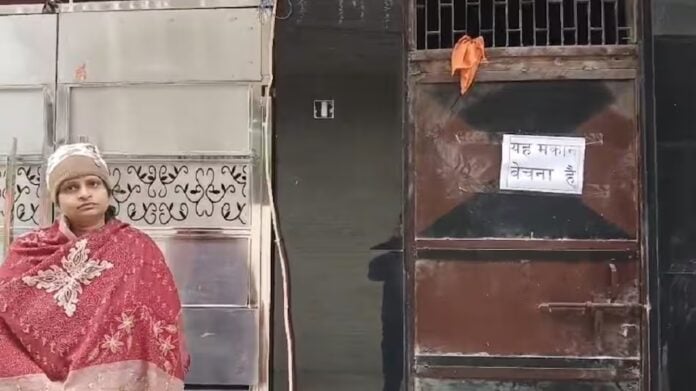
An entire neighbourhood in Agra’s Bhagwan Nagar colony has erupted in anger and fear after around 40 Hindu families simultaneously put up “house for sale” posters on their homes, alleging sustained harassment by local Muslims and police inaction. The unprecedented move has turned a long‑simmering local dispute into a high‑profile law and order and communal sensitivity issue in Uttar Pradesh.
Tense calm in Bhagwan Nagar: 40 houses up for sale
Bhagwan Nagar, located in Agra’s Kamla Nagar police station area, woke up this week to a striking sight: “मकान बिकाऊ है” and “मकान बेचना है” notices pasted on more than 40 houses in Block‑A. Residents say the posters are both a distress signal and a symbolic act of protest, reflecting a breakdown of trust in local policing and the security environment.
Local reports indicate that the affected stretch is overwhelmingly Hindu and that families claim they no longer feel safe keeping their children and women outside even for routine work, due to repeated altercations and threats from a group of local Muslim youths. Many residents have openly spoken of “palaayan” (migration) as an option if security and justice are not assured, becoming a case of forced exodus.
Trigger incident: clash during a family function on 2 February
According to residents, tensions peaked on 2 February, when a family function was underway at one of the houses in Bhagwan Nagar. During this ceremony, a local youth identified in Hindi reports as “Sunny” allegedly entered the house and picked a fight, escalating into physical assault inside the premises.
Eyewitnesses quoted in reports say that in the scuffle, there was an attempt to snatch or break a gold chain, resulting in a deep cut on the victim’s neck that required stitches. Neighbours allege that such confrontations are not isolated: they claim that verbal spats, intimidation and fights over small issues have become routine and that this particular incident convinced many that normal life in the lane was no longer possible.
Allegations of harassment and abuse of women
Local women have emerged as key voices in the protest, alleging that the accused youths have repeatedly misbehaved and entered homes aggressively. One woman, identified as Preeti Agarwal in Hindi media, has alleged that when she objected to the misbehaviour, she was abused, manhandled and subjected to obscene language inside her own house.
Residents allege a pattern: young Muslim men coming to the lane, picking quarrels, using abusive language, and, when confronted, turning violent and attempting to terrorise those who resist. Families say the climate of fear has forced them to restrict movement of girls and women, and several households insist they see no option other than selling their homes and leaving if the “dabangai” (goondaism) is not checked.
Residents’ charge: repeated complaints, no effective action
One of the core grievances of Bhagwan Nagar residents is that despite multiple complaints, police action has been either delayed or ineffective. Locals claim they have approached the Kamla Nagar police station several times, but their statements were not recorded with seriousness, and some complainants allege that instead of being protected, they themselves were admonished or discouraged from pursuing the matter.
The perception of official apathy, residents say, emboldened the accused. They allege that after every complaint, the same group of youths would return with more threats, confident that no stringent action would follow. This spiral of complaint, inaction and heightened intimidation is cited by the families as the immediate backdrop to the coordinated “house for sale” protest action.
Local leadership steps in, backs residents’ stand
The area’s elected municipal corporator, identified as Hariom Goyal / Hariom Baba Agarwal in different reports, has publicly acknowledged that serious disputes and fear exist in Bhagwan Nagar. He has supported residents’ claims that complaints against the accused youths have been pending and has demanded firm measures to restore confidence and peace in the locality.
The corporator has emphasised that the administration must treat the matter not just as a minor neighbourhood quarrel but as a serious law and order issue, especially given the scale of the protest—over 40 families synchronising a decision to display “for sale” notices on their homes. His intervention has increased pressure on the police and district authorities to be seen as responsive and impartial.
Police narrative: “family dispute” and compromise
Faced with viral images of “house for sale” posters and rising media scrutiny, Agra Police deployed senior officers to Bhagwan Nagar and held talks with both sides. Police teams reportedly went door‑to‑door trying to pacify residents and urging them to remove the posters, while assuring an impartial inquiry.
ACP (Chhata) Sheshmani Upadhyay has presented a different framing of the dispute. He has stated that the core of the issue lies in a property‑linked family quarrel involving a widow named Sitara Begum and a tenant or related person named Shahzad, who lives in her house with his children. According to the ACP, Sitara Begum wants the house vacated, while Shahzad has now told police that he will leave the premises with his family, and the matter has been “settled through dialogue”.
Police have thus publicly termed the issue as primarily a “parivaarik vivaad” (family dispute) that escalated, rather than a broader communal or organised extortion racket. Officials have claimed that after counselling both sides, the situation is “normal” and under control, even as residents insist their security concerns remain unresolved.
“Forced migration” fears and communal undertones
Several news portals have reported the harassment of Hindu families by a Muslim family and its associates, a classic case of selective intimidation leading to the threatened migration of about 40 Hindu households. These reports highlight the religious identities of the accused—referring to individuals such as Shahbaz or Shahnavaz and their sons—and frame the exodus threat as part of a wider pattern seen in various towns of western Uttar Pradesh in past years.
Residents quoted in such reports say that when a cluster of Hindu families in one pocket simultaneously talks about selling houses and leaving because of fear linked to one dabang family, the administration should recognise the communal sensitivity of the situation and act swiftly to prevent demographic change driven by fear rather than free choice. Even though police have termed it a family dispute, the perception among many locals, amplified by sympathetic media, is that this is a systematic attempt at pressuring Hindu families to vacate a profitable and strategically located neighbourhood.
Governance questions: can “normalcy” be declared so easily?
The episode also exposes institutional gaps: residents report that only after posters went up on around 40 homes and the matter hit the headlines did serious engagement by senior officers and public representatives begin in earnest. For many families, the posters served as the only effective instrument to force the system to acknowledge their plight. Whether this leads to genuine long‑term security or only cosmetic “peace meetings” will become clear in the coming weeks.
What lies ahead for Bhagwan Nagar’s families?
For now, the posters remain the most visible symbol of protest and desperation in Bhagwan Nagar, with residents declaring that they will not remove them until they receive firm, written assurances of safety and see concrete action against the accused youths. Many say they are willing to withdraw the call for migration if strong FIRs, arrests where warranted, and sustained patrolling restore their confidence that their children can step out without fear.
The Agra incident has already travelled beyond city limits, feeding into larger debates about “dabang raj”, alleged one‑sided policing, and the silent pressures that can push whole clusters of families—especially Hindus in Muslim localities—to consider selling ancestral homes. As Bhagwan Nagar waits for the next steps from police and administration, the line of “house for sale” posters stands as a stark indictment of a system that, in the eyes of its own citizens, failed to act until the threat of collective exodus forced it to pay attention.
