


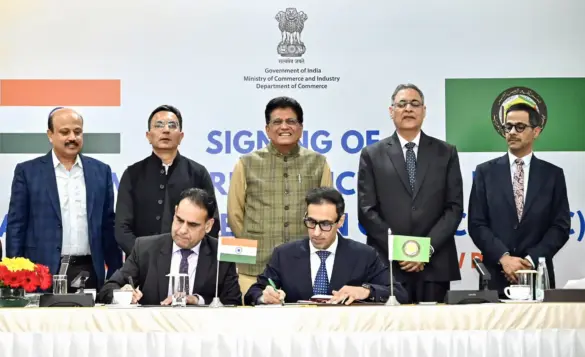
“Why Does the India–GCC Free Trade Talks Matter Now?”, India Narrative, Feburary 19, 202
“The decision by India and the Gulf Cooperation Council (GCC) to formally restart negotiations on a Free Trade Agreement (FTA) after nearly fifteen years represents a significant geoeconomic inflection point between India and the GCC states. It underscores how trade diplomacy is emerging as a primary instrument of India’s strategic positioning in the West Asian region. Collectively, the GCC accounts for nearly $180 billion in trade with India, positioning it as India’s largest trading bloc partner. Beyond trade, the GCC states host over 9 million Indian expatriates and supplies the bulk of India’s hydrocarbon imports. Yet what is notable about this resumption of FTA negotiations is that the relationship is no longer energy-driven and is now driven by geoeconomic realignments.
The Gulf states are undergoing structural transformation. Mega projects, sovereign wealth investments, and non-oil industrial expansion are redefining their economic models. Manufacturing, logistics, hydrogen energy, fintech, and advanced infrastructure have become central pillars of Gulf growth strategies. These shifts require deep integration with high-growth Asian markets, and India, with its labour force and technological capabilities, becomes indispensable. At the same time, New Delhi is also redefining its economic strategy. It is aggressively pursuing trade agreements to secure market access and integrate into resilient supply chains. Recent trade pacts, such as CEPA and FTAs, have demonstrated India’s willingness to engage in tariff rationalisation and regulatory alignment when strategic benefits outweigh protectionist concerns. The revival of these FTA discussions therefore reflects structural convergence.
The earlier negotiations were stalled in 2008 amid disagreements over tariffs, petrochemical access, services mobility, and standards. But the geopolitical and economic context is vastly different at present. Global supply chains are being reconfigured amid great-power competition, trade barriers, and technological decoupling. Regional middle powers are responding by expanding economic partnerships across multiple poles. The Gulf states have adopted multi-vector economic diplomacy, i.e., deepening ties simultaneously with China, the United States, Europe, and Asia. India fits naturally into this strategy as a stable growth market with complementary economic strengths…….”
Read full article at indianarrative.com
