


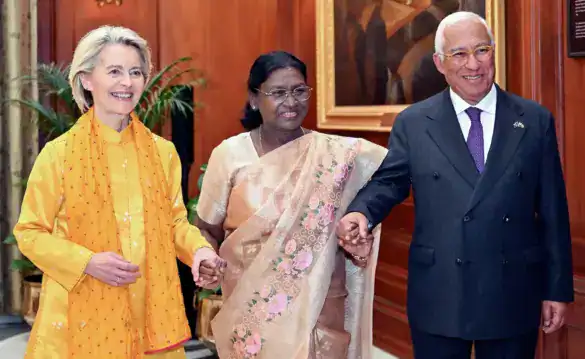
“India-EU FTA: Unlocking Economic Synergy and Geopolitical Resilience in a Fractured World Order”, India Narrative, January 30, 2026
“India and the European Union sealed a landmark Free Trade Agreement (FTA) on January 27, 2026, at the India-EU Summit in New Delhi, hailed as the “mother of all deals” after two decades of intermittent negotiations. Spanning a combined market of two billion consumers and a quarter of global GDP—roughly $27 trillion—this pact arrives amid escalating US tariff threats under President Donald Trump’s second term. For India, it accelerates economic diversification and ‘Make in India’ ambitions; for the EU, it fortifies supply chain resilience against over-reliance on China. Geopolitically, the FTA recalibrates power dynamics in the Indo-Pacific, positioning both as counterweights to unilateralism.
Negotiation Milestones and Framework
Talks, relaunched in 2022 after a 2007-2013 stalemate, gained momentum through 15 rounds, culminating at the 16th India-EU Summit. Commerce Secretary Rajesh Agrawal and European Commission President Ursula von der Leyen announced the breakthrough, with formal signing slated post a 5-6 month legal scrub for ratification by mid-2027. The comprehensive pact encompasses goods (96% tariff liberalization), services (preferential access for IT, finance), investments, government procurement, intellectual property, sustainable development, and customs facilitation. Sensitive sectors like Indian agriculture and EU dairy face phased reductions or exclusions, balancing domestic lobbies. This “living agreement” includes review clauses for digital trade and green tech, reflecting post-COVID supply chain lessons.
The deal builds on interim frameworks like the 2024 Trade and Technology Council (TTC), fostering collaboration in semiconductors, AI governance, and critical minerals. India’s concessions on data localization and EU commitments to ease non-tariff barriers (e.g., sanitary standards) were pivotal breakthroughs……”
Read full article at indianarrative.com
