


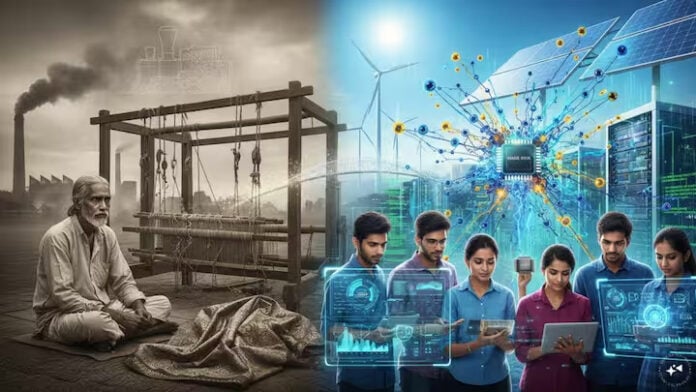
“The last time machines rose, Bharat fell. Not this time”, Firstpost, 23 Sep 2026.
“In 1750, on the eve of the first machine age, India produced about a quarter of the world’s manufactured goods; India and China together, over half. Our weavers were the finest on earth; Dhaka muslin sold in London for its weight in silver. Then the machines rose, in someone else’s country. By 1900, India’s share of world manufacturing had collapsed to under two per cent. We did not merely miss the Industrial Revolution. We were unmade by it: Bengal’s looms fell silent so that Manchester’s could sing, and Dadabhai Naoroji spent a lifetime documenting the drain. Even the coal of Jharia, dug from the tribal districts I would administer two centuries later as a collector, fired the furnaces of someone else’s century.
I begin with this wound because the second machine age has now arrived, and this one moves faster. The men building artificial intelligence say so themselves. Anthropic’s chief executive predicts systems smarter than Nobel laureates by 2027 and this month asked the world to slow the pace of his own industry. Google DeepMind’s Demis Hassabis calls human-level AI within the decade a coin toss. MIT researchers estimate that today’s AI can already perform work equal to 11.7 per cent of the American labour market, some $1.2 trillion in wages, while PwC projects AI adding $15.7 trillion to global GDP by 2030, a sum larger than the output of China. Steam took a century to redraw the world’s hierarchy. Intelligence will take a generation………”
Read the full article at Firstpost.
