


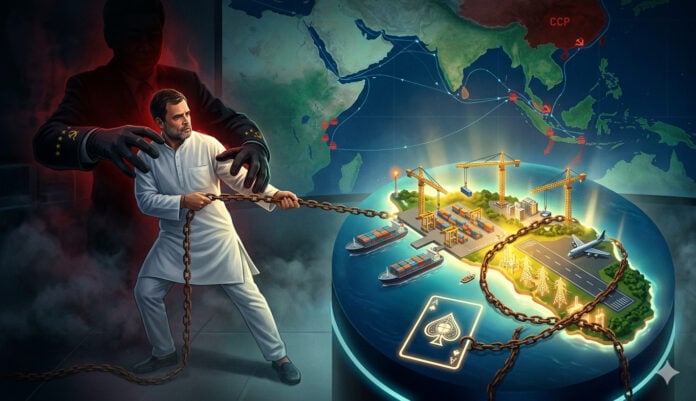
“The Great Nicobar Project is something China would never want. Why are Rahul Gandhi and his mother opposing it so strongly? India’s geopolitical trump card explained”, OpIndia, April 29, 2026
“A 2003 internal speech by then-President Hu Jintao warned his leadership of what he called the ‘Malacca Dilemma‘, China’s existential reliance on a waterway it does not control and cannot easily avoid, somewhere in the Chinese Communist Party archives.
That problem has continued to grow worse over the past 20 years. As of 2025, more than 80% of China’s oil imports, which are valued at about $312 billion a year, come through the Strait of Malacca, which is only 2.8 km wide at its narrowest point. Approximately $3.5 trillion in global business, or two-thirds of all Chinese marine traffic, travels through these waterways annually. Every day, China uses more than 15 million barrels of oil. Just 3.7 million are transported by its overland pipelines. The maths is harsh. Beijing’s economic engine is based on a bottleneck that it fears and cannot fix.
Now think about India’s position. Geostrategically speaking, the Andaman and Nicobar Islands, a 700+ kilometre stretch that spans the entrance to the Malacca Strait, are a natural aircraft carrier that India was gifted by geography. Great Nicobar, the southernmost island in this series, is nearly equidistant from Singapore, Port Klang, and Colombo. One of the main routes used by ships to enter and exit the strait is the Six Degree Channel, which it overlooks. The waterways around these islands are used for 60% of China’s entire trade. Control of the route is a strategic trump card in any significant battle with China, rather than a negotiation chip. India is finally realising it and moving ahead to use its geographical blessing. And a segment of its own political class is attempting to prevent this…….”
Read full article at opindia.com
